
A 2026 workplace EV charger retrofit should plan $3,200 per port for networked Level 2 charging with dynamic load-sharing as the default.
Move to a separately quoted DC expansion only if three consecutive weeks of session logs show peak queue above one vehicle per port and Level 2 cannot clear by shift.
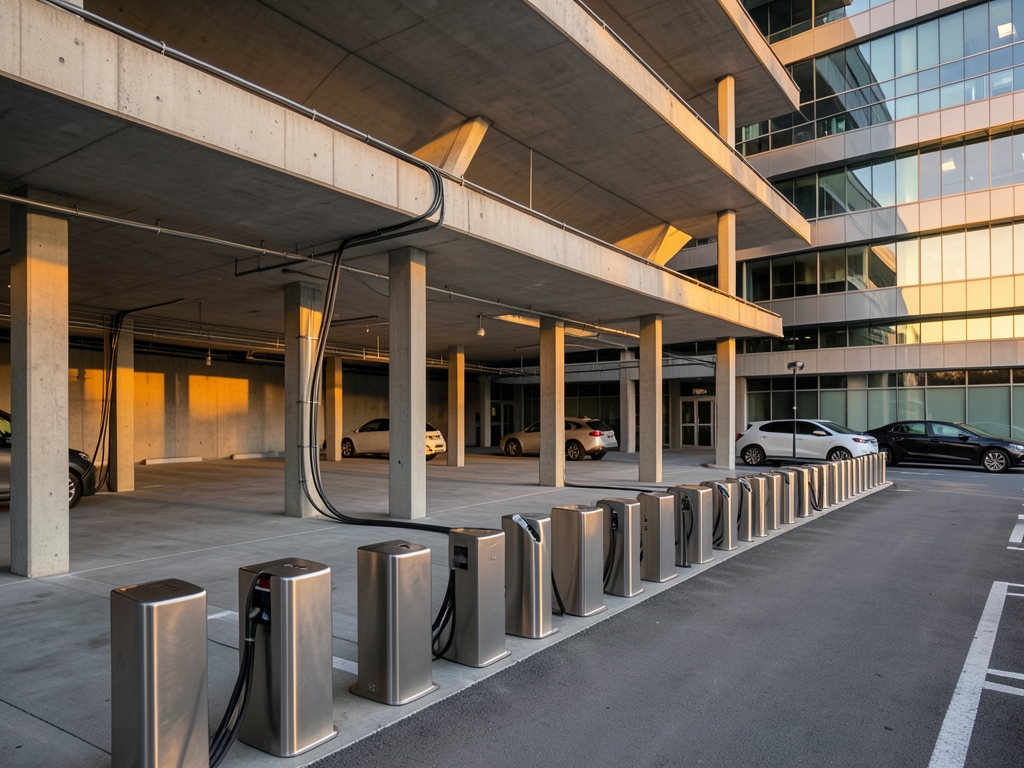
How load-sharing differs from DC expansion
Dynamic load sharing is a control strategy in which networked Level 2 (L2) controllers split a fixed electrical service capacity across multiple charging ports, while DC expansion is a separate high-power AC-to-DC project that adds dedicated conversion equipment and a distinct electrical path. As described in Anari Charge’s 2026 workplace charging guide, dynamic load sharing is the mechanism that lets a site add ports without triggering the most expensive electrical scope, whereas DC hardware operates under a different power architecture and cannot be treated as a simple per-port swap.
In a load-sharing L2 design, a networked charger controller continuously allocates available amperage across connected ports so the group stays within a defined site limit. When one vehicle finishes or reduces its draw, the controller redistributes capacity to other active ports instead of allowing every connector to pull its nameplate maximum at the same time. Before approving a layout, facilities teams should verify three items in the charger submittal: the controller can enforce a hard site-level cap, the ports are commissioned on the same managed network, and the cap can be adjusted if the building’s available capacity changes.
DC expansion follows a different retrofit path. It introduces a separate AC-to-DC high-power conversion system, associated switchgear, and often new utility-side coordination, so it must be scoped, engineered, and quoted as its own electrical project rather than an extension of an L2 port count. A practical check is to ask the electrical engineer to produce two distinct one-line diagrams—one for the networked L2 load-sharing group and one for any proposed DC equipment—so the owner can see where the power conversion, protection, and interconnection responsibilities diverge.
The retrofit boundary for this decision is the site’s existing service capacity. If the load-sharing controller can cap total draw to the capacity that is already available, the L2 design can remain within that boundary and avoid expanding the service footprint. To confirm this, compare the controller’s configured maximum demand against the panel or service allocation documented in the latest load calculation, and review session logs during peak arrival periods to confirm the cap holds under real use. That boundary check keeps the technical comparison grounded in measured site conditions rather than assumptions about charger nameplates.
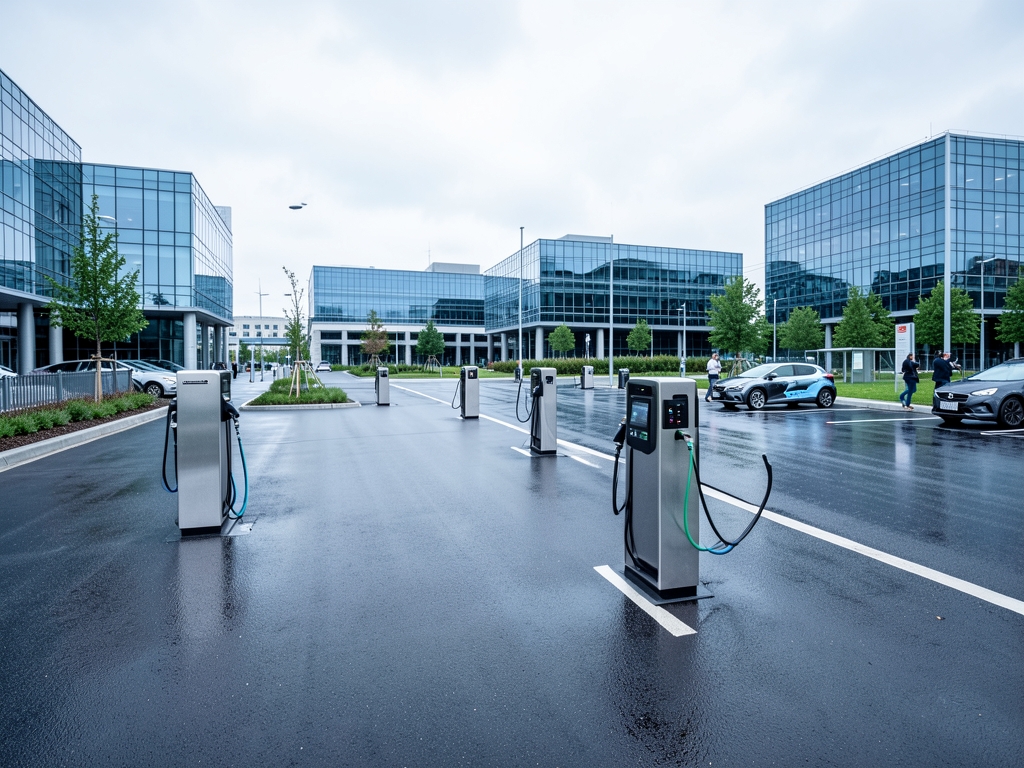
What the 2026 cost sources converge
Two independent 2026 cost snapshots place networked Level 2 workplace charging in a narrow planning band. According to anaricharge.com (2026-10-22), a networked Level 2 port typically costs $3,000–$7,000 installed. A separate estimate from ev-charging-cost-calculator.sundry-know.com (2026-05-20) puts employer-sponsored workplace Level 2 charging at $1,500–$6,500 per port to install. The overlap between $3,000 and $6,500 shows that recent sources converge on a mid-single-thousands figure per port, which gives retrofit planners a defensible starting point before site-specific quotes arrive.
When you compare bids against these ranges, confirm that each quote covers the same scope. Ask vendors to itemize equipment, installation labor, and site preparation separately so you can see whether a low number reflects a simpler site or an incomplete scope. If one proposal sits well below $1,500 per port or well above $7,000 per port, treat the gap as a signal to review assumptions rather than as a direct apples-to-apples comparison.
The demand side of the 2026 picture, also reported by anaricharge.com, explains why many employers are planning ports now rather than later. Employees with workplace charging are six times more likely to drive an EV, and the available source summary says demand is growing twice as fast as new installations. Treat any additional survey percentages, such as access or interest rates, as figures to verify against the underlying anaricharge.com survey before using them in budget assumptions.
For a 2026 retrofit plan, use the cost ranges and demand signals as a two-part check. First, benchmark preliminary per-port estimates against the $1,500–$7,000 corridor and require a written explanation for any outlier. Second, document current and expected driver demand at your site so the number of ports you price matches real usage patterns rather than a generic count. This approach keeps early budgeting grounded in published 2026 figures while leaving room for site conditions to refine the final number.
Level 2 load-sharing vs DC: winner
| Option | Fit to $3,200/port target | What it requires | Decision |
|---|---|---|---|
| Level 2 load-sharing | Fits the $3,200/port target | Networked chargers plus a load controller | Winner as the base retrofit |
| DC expansion | Does not fit the $3,200/port target | High-power service and separate equipment | Only after queue proof |
The practical distinction for an approval committee is how the project is priced and governed. A Level 2 load-sharing retrofit can be evaluated as a repeatable per-port package, which makes bids comparable and keeps the base project inside a workplace retrofit frame. DC expansion cannot be judged on the same per-port basis because it changes the scale of electrical work, equipment procurement, and construction coordination. If a proposal mixes both approaches into one number, require the vendor to separate them so the base Level 2 decision is not obscured by a high-power add-on.
For procurement, ask each bidder to confirm the base scope as networked Level 2 ports managed by a load controller and priced against the $3,200/port planning target. Any DC recommendation should be submitted as a standalone scope with its own assumptions, schedule, and utility coordination path. This keeps the default decision disciplined: Level 2 load-sharing wins the retrofit comparison, and DC expansion is considered only when operating evidence proves the base system cannot meet demand.
Costs to carry in the 2026 budget
The 2026 budget must carry the non-hardware lines a workplace retrofit requires: utility service upgrade, networking, ADA compliance, billing, and the 30C tax-credit loss. Treat each as a separate approval item so the per-port hardware target does not hide the work required to make the chargers usable, accessible, and billable.
Remove expired federal offsets before you model net cost. According to anaricharge.com (2026-10-22), the federal 30C charger tax credit ended mid-year 2026. A May 2026 estimate from ev-charging-cost-calculator.sundry-know.com assumed 30C coverage of up to 30% of costs, capped at $100,000 per location; that assumption must not be subtracted in a 2026 retrofit budget. If your finance team wants to test an incentive scenario, require written confirmation of current eligibility from a qualified tax advisor and keep the base budget fully funded without the credit.
Budget a separate utility-service line and do not approve the final port count until it is priced. The anaricharge.com and ev-charging-cost-calculator.sundry-know.com cost summaries provide no dollar figure for a service upgrade, so the correct method is to request a utility capacity review and an electrical contractor quote that covers panel capacity, transformer or service changes, trenching, and permit fees. Compare that quote against the planned port count before issuing purchase orders, because service work can change the feasible scope of the project.
Carry networking and billing as operating requirements, not optional add-ons. Networked ports need reliable connectivity, software configuration, and a payment or access workflow; require vendors to itemize hardware communications, subscription fees, and billing administration in the same proposal. Add ADA compliance to the site assessment early, since accessible routes, stall layout, signage, and mounting details can affect civil and electrical scope. A practical rule is to reject any proposal that bundles these items into an unlabeled “installation” total.
Use the Wins Parking workplace EV charging installation guide (winsparking.com) as a checklist to confirm every non-hardware line is scoped, quoted, and assigned to an owner before construction begins. When each line has a documented estimate or a verified “not required” determination, the retrofit budget reflects the full cost of deployment rather than only the equipment on the wall.
Where the 2026 evidence runs out
The 2026 sources reviewed for this retrofit decision do not publish an exact $3,200-per-port installed quote. According to anaricharge.com (2026-10-22) and ev-charging-cost-calculator.sundry-know.com (2026-05-20), available workplace estimates are presented as ranges rather than a site-specific price. Treat $3,200 per port as an internal planning target only, and require three itemized installer quotes before committing funds. Each quote should separate hardware, labor, networking, permitting, and any electrical work so the team can compare scope line by line instead of relying on a single blended number.
The same evidence gap applies to direct current expansion. The anaricharge.com and ev-charging-cost-calculator.sundry-know.com cost summaries do not provide an installed cost for a DC fast charger, a utility service upgrade, or trenching. Those items must be quoted separately as part of a distinct project and cannot be inferred from Level 2 pricing. Before approving a DC scope, request a utility capacity review, a site civil estimate for conduit or trenching, and a charger-specific equipment and installation proposal. This keeps the Level 2 decision grounded in verified quotes and prevents DC assumptions from distorting the retrofit budget.
Site conditions can also change whether the default rule holds. Use the checks below to confirm that load-sharing remains feasible within existing electrical capacity and that accessibility or site-work requirements do not turn a simple port addition into a larger construction project.
Frequently Asked Questions
How long must session logs show a peak queue above one vehicle per port before considering a DC expansion?
A separately quoted DC expansion should only be considered if three consecutive weeks of session logs show a peak queue above one vehicle per port and Level 2 cannot clear by shift.
Besides queue length, what operational condition must be met before moving to a DC expansion?
Level 2 must be unable to clear the vehicle queue by shift in addition to the sustained peak queue threshold being exceeded.
How does dynamic load sharing keep a group of chargers within a site's electrical limit?
A networked charger controller continuously allocates available amperage across connected ports so the group stays within a defined site limit instead of allowing every connector to pull its nameplate maximum.
What happens to available charging capacity when one vehicle finishes or reduces its draw in a load-sharing system?
When one vehicle finishes or reduces its draw, the controller redistributes capacity to other active ports.
Why can adding load-sharing Level 2 ports avoid the most expensive electrical scope?
Dynamic load sharing splits a fixed electrical service capacity across multiple charging ports, allowing a site to add ports without triggering the most expensive electrical scope.
What makes DC expansion fundamentally different from adding more Level 2 ports?
DC expansion is a separate high-power AC-to-DC project that adds dedicated conversion equipment and a distinct electrical path, operating under a different power architecture than Level 2.
Quick answers
| What is the default planning approach for a 2026 workplace EV charger retrofit? | The default is to plan for networked Level 2 charging with dynamic load-sharing at the per-port planning target mentioned above. |
| When should a workplace consider moving to a separately quoted DC expansion? | A workplace should move to a separately quoted DC expansion only if three consecutive weeks of session logs show peak queue above one vehicle per port and Level 2 cannot clear by shift. |
| How does dynamic load sharing differ from DC expansion? | Dynamic load sharing is a control strategy in which networked Level 2 controllers split a fixed electrical service capacity across multiple charging ports, while DC expansion is a separate high-power AC-to-DC project that adds dedicated conversion equipment and a distinct electrical path. |
| How does a load-sharing Level 2 design allocate power among connected vehicles? | A networked charger controller continuously allocates available amperage across connected ports so the group stays within a defined site limit, redistributing capacity to other active ports when one vehicle finishes or reduces its draw. |
| Why is dynamic load sharing advantageous when adding charging ports? | Dynamic load sharing lets a site add ports without triggering the most expensive electrical scope, whereas DC hardware operates under a different power architecture and cannot be treated as a simple per-port swap. |
Also worth reading: Heating and cooling cost per square foot: $76,833—Payroll Cost, Not Price: Heating and cooling cost per · Rooftop economizer retrofit: ASHRAE 90.1-2022 vs fixed 55°F setpoint: Rooftop economizer retrofit: ASHRAE 90.1-2022 · Alarm routing delay: 15-minute building management system lag raises vendor dispatch cost: Alarm routing delay: 15-minute building